
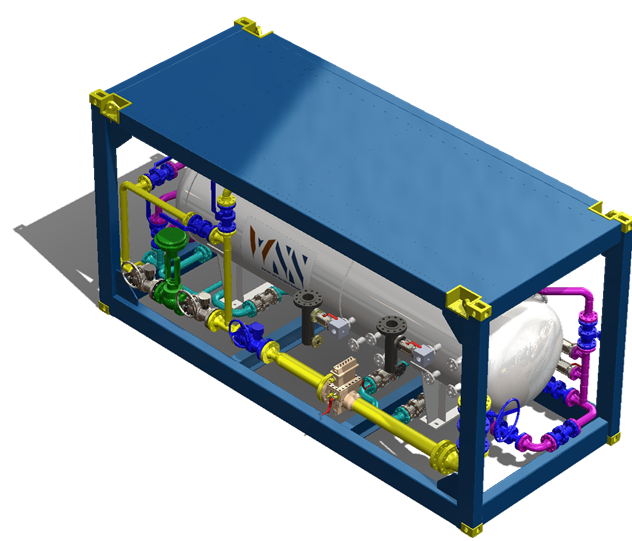
Gas Conditioning Skids: Comprehensive Solutions for Gas Treatment
Gas conditioning skids play a crucial role in preparing natural gas for downstream applications by controlling pressure, temperature, and impurities. Well Services Solution's gas conditioning skids are designed to offer comprehensive solutions for various gas treatment processes, including H2S scrubbing, CO2 scrubbing, gas dehydration, and gas metering. Let's explore these different types of skids in detail:
H2S Scrubbing Skids:
H2S scrubbing skids are essential for removing hydrogen sulfide from natural gas streams. These skids typically employ wet scrubbing technology, which involves:
- A scrubber unit where contaminated gas interacts with an alkaline solution
- Absorption of H2S into the liquid, forming less toxic compounds
- Optimization of gas-liquid contact through turbulence zones or packing materials
The process can remove 90% to 99% of H2S, depending on the design and absorbent used. Some systems use caustic soda (NaOH) as the reagent, which reacts with H2S to form sodium sulfide.
CO2 Scrubbing Skids:
CO2 scrubbing skids are designed to capture and remove carbon dioxide from gas streams. The process typically involves:
- A scrubber unit where the gas is washed and cooled
- Removal of water-soluble components like alcohols
- Use of solvents such as monoethanolamine (MEA) to absorb CO2
- A stripper unit where CO2 is separated from the solvent for further processing or storage
These systems can capture 90% to 99% of CO2 from exhaust gases, contributing to emissions reduction efforts.
Gas Dehydration Skids:
Gas dehydration skids remove moisture from natural gas to prevent corrosion and hydrate formation. Key components include:
- Separators to remove free water
- Absorber towers with desiccants like glycol
- Regeneration systems for the desiccant
- Heat exchangers for temperature control
These skids ensure that the gas meets pipeline specifications for water content, typically achieving dewpoints as low as -50°F.
Gas Metering Skids:
Gas metering skids are crucial for accurate measurement of gas flow. They often include:
- High-precision flow meters (e.g., ultrasonic or Coriolis meters)
- Pressure and temperature sensors
- Flow computers for real-time calculations
- Sampling systems for composition analysis
These skids ensure precise metering for custody transfer and process control applications.
JT (Joule-Thomson) Skids:
JT skids utilize the Joule-Thomson effect to cool gas streams and separate heavier components. These skids are ideal for gas conditioning and processing systems where efficient cooling and separation are necessary.
Applications:
- Natural gas processing
- Emissions reduction
- Gas flow measurement
- Gas treatment and conditioning
Well Services Solution's Gas Conditioning Skids:
Well Services Solution's gas conditioning skids are designed to offer comprehensive solutions for gas treatment. Key features include:
- Multi-stage separation processes for optimal gas purity
- Integration with heating systems, filters, and scrubbers
- Compact, modular designs for easy installation and operation
These skids typically incorporate:
- Inlet separators to remove bulk liquids and solids
- Coalescing filters for fine particle removal
- Heaters to adjust gas temperature
- Pressure regulation systems
- Instrumentation for monitoring and control
The modular design allows for easy transportation and quick installation, reducing on-site construction time and costs. By offering a range of gas conditioning skids, Well Services Solution provides tailored solutions for various gas treatment requirements, ensuring that natural gas meets the necessary specifications for downstream applications while maintaining operational efficiency and environmental compliance.